 Futureproof
Laboratory safety, explained
Futureproof
Laboratory safety, explained
Futureproof
Laboratory safety, explained
Futureproof
Laboratory safety, explained
Please confirm you are 18 or older to continue.
This page is an editorial and informational resource about the safety paperwork of a small laboratory in the United Kingdom: what the COSHH Regulations ask for, how a safety data sheet is read, and how materials are received, stored, labelled and disposed of.
Nothing is sold on this page. It is a published editorial resource. Nothing here is an offer, no account can be opened and no order can be placed on this site. It is general information, not professional health and safety advice for any particular workplace.
Nothing on this page describes, recommends, compares or makes any claim about any product, material, treatment or substance, and no such claim is made or implied anywhere on this site. This resource is written for readers aged 18 and over.
COSHH asks for a written judgement about every material before anyone handles it. What that judgement has to contain, and what it does not.
A safety data sheet is a fixed structure. Knowing which section answers which question turns a dense document into a two minute read.
Gloves are the last line, not the first. The hierarchy of control says what to try before anything is worn.
An alphabetical shelf puts incompatible materials side by side. Segregation, labelling and a record of what came in and what went out.

In a large laboratory, safety has a department. There is a safety officer, a stores manager, a waste contract, an induction that takes most of a morning and a folder of assessments somebody is paid to keep current. In a small laboratory, or in a workroom where analytical work is one activity among several, all of that is usually one person's afternoon, fitted in around the work itself. The law is the same in both places. The difference is that in the small one nobody else will notice when something is missing.
This guide is written for that second situation. It walks through the safety paperwork a small UK laboratory actually needs, in the order the work happens: what the regulations ask for, how to read the document that arrives with every hazardous material, what the symbols on a label mean and what they do not, how to write an assessment that says something, how to choose controls in the right order, what to check when a delivery arrives, how to store things so that the shelf itself is not a hazard, and what to do with what is left at the end.
None of it is complicated. Most of it is a matter of doing a small number of things before the first container is opened rather than after.
The central UK law here is the Control of Substances Hazardous to Health Regulations 2002, as amended, known everywhere as COSHH. It sits underneath the Health and Safety at Work etc. Act 1974 and alongside the Management of Health and Safety at Work Regulations 1999, and it is enforced by the Health and Safety Executive (HSE) or, for some premises, the local authority.
COSHH applies to employers, and in most respects to the self-employed, wherever work involves a substance that could harm health: chemicals, products containing chemicals, dusts, fumes, vapours, mists, gases and biological agents. Its logic is simple. Before work with a hazardous substance starts, someone has to have thought about it properly, and the thinking has to be good enough to act on. The regulations do not ask for paperwork for its own sake. They ask for a judgement, and the paperwork is the evidence that the judgement was made.
That ordering matters more than any individual control. An assessment written after a year of work tends to describe what people already do. An assessment written before the first container is opened is the only one that can change what they do.
HSE sets out the duties as eight steps. They are worth reading as a sequence rather than a checklist, because each one depends on the one before it.
Two details are regularly missed. First, the assessment must be reviewed regularly, and immediately if there is reason to think it is no longer valid or the work has changed significantly. An assessment is not finished when it is written. Second, where a business employs five or more people, the Management Regulations require the significant findings of its risk assessments to be recorded. Below that number the thinking is still required. Only the obligation to write it down changes, and writing it down is almost always worth doing anyway.
For a small number of substances there are also Workplace Exposure Limits, published by HSE in its guidance document EH40. Where a limit exists, exposure must be kept below it. Where one does not, that is not permission to ignore exposure. It means the general duty to control exposure adequately applies on its own.
Every hazardous material placed on the market in Great Britain comes with a safety data sheet, required under UK REACH, in a fixed format of sixteen numbered sections. The format is the same whoever wrote it, which is its greatest strength: once you know where to look, a twelve page document takes a couple of minutes.
| Section | What it tells you | Which decision it feeds |
|---|---|---|
| 1. Identification | Product identifier, supplier, emergency telephone number | Is this the sheet for the material actually on the shelf? |
| 2. Hazards | Classification, pictograms, signal word, hazard and precautionary statements | The starting point of the assessment |
| 3. Composition | Ingredients and their individual classifications | Hidden hazards in a mixture |
| 4. First-aid measures | What to do after contact, by route | What must be to hand before work starts |
| 5. Firefighting | Suitable extinguishing media, combustion products | Fire plan, storage location |
| 6. Accidental release | Containment and clean-up | What goes in the spill kit |
| 7. Handling and storage | Conditions, incompatibilities, temperature | Where it lives and what it must not sit next to |
| 8. Exposure controls | Exposure limits, engineering controls, protective equipment | The control measures in the assessment |
| 9. Physical properties | Appearance, state, flash point, solubility, particle size | Dust, vapour and fire behaviour |
| 10. Stability | Reactivity, conditions and materials to avoid | Segregation, shelf life |
| 11. Toxicology | Known effects, and what has not been tested | How cautious the controls need to be |
| 12. Ecology | Effects on the environment | Whether it may ever reach a drain |
| 13. Disposal | Waste treatment | The waste route |
| 14. Transport | Classification for carriage | How it may be sent, returned or collected |
| 15. Regulatory | Specific legal requirements | Anything beyond COSHH that applies |
| 16. Other | Revisions, abbreviations, sources | Whether this is the current version |
The sixteen headings are fixed by UK REACH. Content under each heading varies by supplier and material.
A practical reading order for an assessment is 2, 8, 7, 10, 11, 6, 13, and then the rest. Section 2 tells you what kind of hazard you have. Section 8 tells you what the supplier considers adequate control. Sections 7 and 10 tell you how to store it and what it must be kept away from. Section 11 tells you how much is known, which is often the most important thing on the page. Sections 6 and 13 tell you what happens when it escapes and when it is finished with.
Check the date and the revision number in section 16. A sheet kept in a drawer for four years is probably not the current one, and classifications do change.
Labels in Great Britain follow the GB CLP Regulation, which uses the internationally harmonised system of classification. A compliant label carries up to four kinds of information, and each one does a different job.
| Pictogram | What it indicates |
|---|---|
| Explosive | Unstable explosives, self-reactive and some organic peroxide hazards |
| Flammable | Flammable gases, liquids and solids; materials that heat or ignite on their own |
| Oxidising | Materials that can cause or intensify a fire by supplying oxygen |
| Gas under pressure | Compressed, liquefied or dissolved gases in cylinders |
| Corrosive | Materials that damage skin, eyes or metals on contact |
| Acute toxicity | Serious effects from a single short exposure |
| Harmful or irritant | Less severe acute effects, irritation, skin sensitisation |
| Serious health hazard | Longer term effects such as respiratory sensitisation or effects on organs |
| Environment | Hazardous to the aquatic environment |
Names shortened for reading. The full classification is in section 2 of the safety data sheet.
The pictogram tells you which family of hazard you are dealing with. The signal word tells you how severe the classification is. The H statements tell you the detail, and they are what belongs in the assessment. The P statements are the supplier's first draft of your controls, and they are a draft, not a finished answer: they are written for every possible user and every possible quantity, so they will always be both too general and, occasionally, not enough.
This is the single most useful idea in the whole guide, and it is the one most often got wrong.
A material with no pictogram on its label has not been shown to be safe. It has been found not to meet the criteria for classification on the data available. For widely used materials that data is extensive and the absence of a pictogram means a great deal. For materials that are new, specialised or made in small quantities, the data may be very limited, and section 11 of the safety data sheet will often say so plainly, in a sentence along the lines of "the toxicological properties have not been thoroughly investigated."
When you read that sentence, the correct response is not relief. It is caution. The established practice in laboratories is to treat a material whose properties are not well characterised as if it were hazardous, and to control exposure accordingly: contained handling, no open powders on an open bench, eye and skin protection, and good hygiene. The assessment should say explicitly that this is the basis on which the controls were chosen, so that nobody later reads the empty pictogram space as a green light.
The same logic applies to fine, light powders in general, whatever their classification. A powder that lifts on a draught from a door or from the movement of a hand is a powder that can be breathed in and can settle on surfaces well away from where it was handled. The hazard of the material and the behaviour of its physical form are two different questions, and section 9 of the sheet is where the second one is answered.
A hazard is the potential of something to cause harm. A risk is the likelihood that it will, in a particular task, to a particular person, at a particular level of severity. A strong acid is a serious hazard. A few millilitres handled in a fume cupboard by a trained person wearing eye protection is a low risk. The same few millilitres decanted on an open bench by someone in a hurry is not.
That is why a useful COSHH assessment is written about a task, not about a substance. "Material X: irritant, wear gloves" is a copy of the label, not an assessment. A useful one answers questions like these:
A short, specific assessment that answers all of those is worth more than a long generic one that answers none of them. HSE's own guidance repeatedly makes the point that the aim is to control risks, not to generate forms.
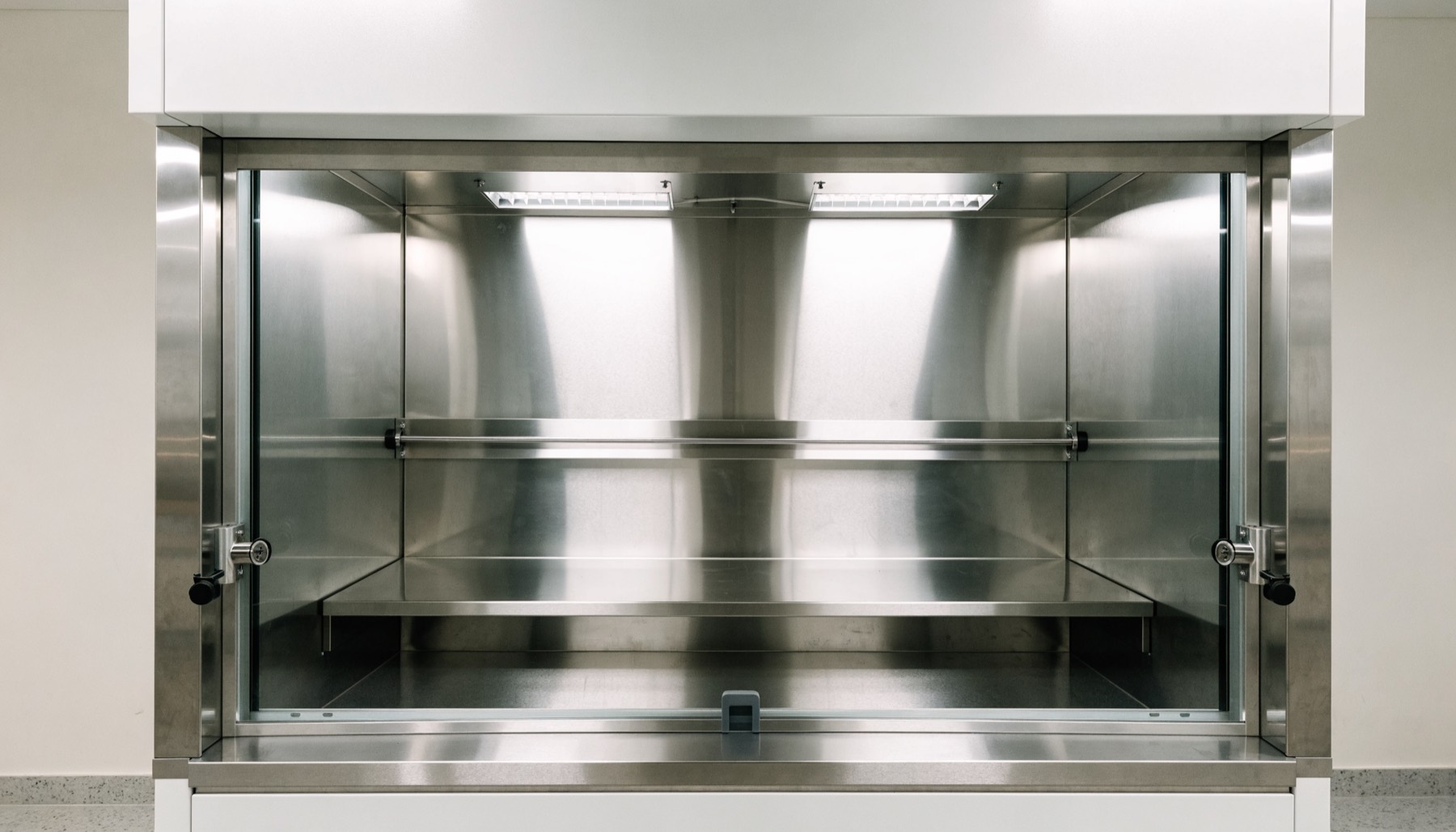
Controls are chosen in a fixed order of preference, and the order exists because each level depends less on people behaving perfectly than the level below it.
Protective equipment is last because it only protects the person wearing it, only while they are wearing it, only if it is the right type, and only if it fits. It is essential, and it is almost never enough on its own.
Local exhaust ventilation carries a specific legal duty that is easy to overlook in a small laboratory. Under COSHH it must be thoroughly examined and tested by a competent person, in most cases at least once every fourteen months, and the record kept. A fume cupboard with a sticker that expired two years ago is a cupboard nobody knows is working. Between tests, simple daily checks help: is the airflow indicator in the normal range, is the sash at or below the marked working height, is the inside clear of stored clutter that disrupts the airflow?
Weighing is where most exposure to fine powders happens. Use a ventilated balance enclosure where the quantities justify it. Keep containers closed except for the moment material is being transferred. Weigh by difference rather than tipping out and returning. Deal with static, which makes light powders jump from a spatula. And clean up with a damp wipe rather than a brush: dry brushing puts back into the air exactly what the enclosure was there to capture.
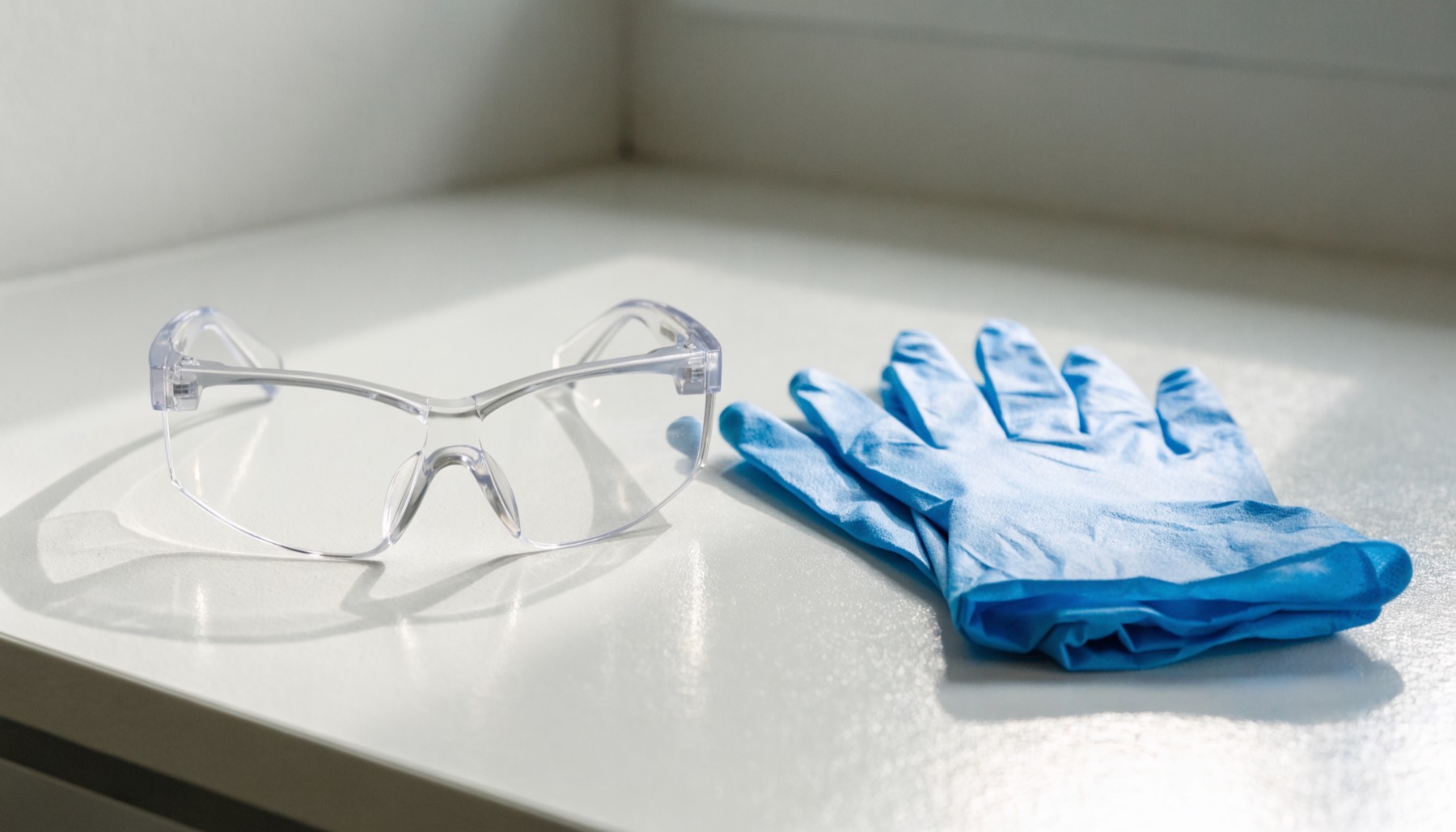
Gloves are not interchangeable. Gloves tested for chemical protection are marked to EN ISO 374, and the standard is built around two ideas worth understanding. Permeation is the process by which a chemical passes through the glove material at a molecular level, even when the glove looks intact. Breakthrough time is how long that takes for a given chemical, and it is graded in performance levels. A glove that performs well against one solvent may perform poorly against another, and thin disposable nitrile gloves, excellent for splash protection and handling solids, are often not suitable for prolonged contact with some solvents at all. The glove supplier's chemical resistance data is the source, not the colour of the box.
Three habits matter as much as the choice of glove. Change gloves as soon as they are contaminated rather than at the end of the task. Remove them without touching the outside with bare skin. And never touch door handles, keyboards or telephones while wearing them, because that is how a contained hazard becomes a building-wide one.
Eye protection should be marked to BS EN 166. Safety spectacles with side protection stop impact and some splashes. Goggles are needed where there is a real risk of liquid splash or fine dust reaching the eye from the side. A face shield protects the face but is worn with, not instead of, spectacles or goggles.
Laboratory coats protect clothing and skin from small spills, and they should be fastened, kept in the laboratory, and never worn into areas where food and drink are consumed. Respiratory protection, where it is genuinely needed, is its own discipline: tight fitting masks must be fit tested to the individual wearer, which is a legal expectation rather than a nicety, and the need for one is usually a sign that an engineering control higher up the hierarchy deserves another look.
Most safety systems begin at the bench. A better place to begin is the door, because goods-in is the one moment when every material passes through the same pair of hands, and it is the cheapest point at which to catch a problem.
That last step is the one that pays for itself. A simple inventory, even a single spreadsheet, is what lets you answer the questions that matter later: what do we hold, how much, since when, and what is due for disposal.

Alphabetical order is the natural way to arrange a shelf and one of the worst. It places materials next to each other for no reason except their names, and some of the most hazardous combinations in a laboratory are between materials that sit a letter or two apart. Storage should be arranged by compatibility, using section 7 and section 10 of each safety data sheet.
A domestic refrigerator is not a laboratory refrigerator. The thermostat contacts and the light switch inside an ordinary fridge are ignition sources, and a small quantity of vapour from a flammable solvent inside a closed compartment can be enough. Anything flammable that needs to be kept cold belongs in a refrigerator specifically designed for it, with no ignition source inside the storage space. Every laboratory fridge should carry a clear notice that no food or drink is ever to be kept in it, and its temperature should be checked and recorded rather than assumed.
Write the date received and the date first opened on each container. Some materials degrade once opened, and some become more hazardous as they age. A container with no dates on it is a container whose history nobody can reconstruct, and an inventory rotated oldest first keeps that from happening.
Supplier containers arrive labelled. The labelling failures in a laboratory happen afterwards, on the containers people fill themselves: a portion decanted for the day, a solution made up for a week, a sample split between two people.
Every secondary container needs, at a minimum, the identity of what is in it, the main hazard, the date it was prepared and the name or initials of the person who prepared it. For anything kept longer than a working day, add the concentration and any storage condition. A permanent marker and a label take ten seconds.
The unlabelled container is the most expensive object in a laboratory. Nobody can safely use it, nobody can safely pour it away, and a waste contractor has to treat it as an unknown, which costs far more to identify and dispose of than the material ever cost in the first place.
The emergency plan required by COSHH does not have to be elaborate in a small laboratory, but it does have to exist before it is needed. Three things should be settled in advance.
Near misses deserve as much attention as incidents: the container that nearly fell, the glove that split, the fume cupboard alarm that sounded and was silenced. They are free information about where the controls are thin. Some serious incidents and dangerous occurrences must also be reported to HSE under the Reporting of Injuries, Diseases and Dangerous Occurrences Regulations 2013 (RIDDOR), and it is worth knowing which, before one happens.
Waste is where good laboratories most often become careless, because by the time something is waste it feels like it has stopped being a hazard. It has not. In law, anyone who produces, stores, transports or disposes of waste owes a duty of care under section 34 of the Environmental Protection Act 1990: to keep it safe, to pass it only to someone authorised to take it, and to describe it accurately when they do.
A small laboratory rarely needs a large contract. It does need a named, licensed contractor, a labelled place where waste waits for collection, and a record of what left the building and when.
The failure mode of a small laboratory's safety system is not dramatic. It is drift. The assessment was good when it was written, and then the work changed a little at a time. A new material arrived and was used in the same way as an old one. A second person started helping. The quantities grew. The fume cupboard test date passed. None of these announce themselves, and each one moves the real situation a little further from the one on paper.
The defence is a calendar and a trigger list. Review each assessment on a fixed schedule, and review it at once when any of the following happens: a new material, a new task, a larger quantity, a new person, a new location, an incident or a near miss, a revised safety data sheet, or a failed test of an engineering control. Record the review even when nothing changes, with a line saying so and why.
Training is part of the same system. Everyone who handles a hazardous material should have read the relevant assessment, know where the safety data sheets are, know what the controls are for, and know what to do when something goes wrong. The record of that training should say what was covered and when, not just that someone attended.
None of these questions need a safety department to answer. They need someone to ask them, in order, before the work starts and again at intervals afterwards. That is the whole of the system described here: a judgement made in advance, written down plainly, kept current, and acted on. A small laboratory that does that is not a smaller version of a safe laboratory. It is a safe one.
Who publishes this resource, why it exists, and how to reach the editor with a correction or a question about the guide.
Futureproof publishes an editorial resource on laboratory safety paperwork in the United Kingdom: what COSHH asks for, how a safety data sheet is read, and how materials are received, stored, labelled and disposed of in a small laboratory. It exists because the regulations are clear, the guidance is extensive, and in a small workplace the job of turning both into practice usually falls to one person with other work to do. The position behind the site is a plain one: the safest moment to think about a material is before anyone opens it.